


Late spring flowering perennials
Perennial planting for colour and structure between spring and early summer
Late spring is an important stage in the planting year. Early bulbs, spring-flowering shrubs and woodland perennials are beginning to recede, while the main summer display is not yet fully in place. In well-balanced planting schemes, this period should not feel like a gap. It should feel continual, with one group of plants giving way to the next without any loss of structure or coverage.
This is where late spring flowering perennials are particularly useful. They help maintain continuity across mixed borders, public planting schemes and larger landscape settings by providing flower, foliage and form at a point when the planting still needs support. Some give a short but defined display, while others continue well into early summer. Several also provide nutrition to pollinators at a time when insect activity is increasing.
These perennials are often doing more than one job. They may be filling space left by fading bulbs, covering the base of shrubs, linking stronger subjects together, or adding the vertical or mounding forms needed to make a border feel complete. Their value lies both in flower colour and in how they perform within the wider scheme.
When selecting plants for late spring interest, it is worth considering a species’ flowering period, mature size, foliage quality and site conditions. A plant that flowers well but leaves poor foliage behind may be less useful than one with a lighter display but better structure through the rest of the season. Sun, shade, moisture levels and soil type all influence growth, and the most effective planting usually comes from matching each perennial to the conditions it prefers.
Late spring flowering perennials we recommend:

Geranium phaeum

Geranium macrorrhizum
Geranium phaeum
An upright hardy geranium suited to partial shade and woodland-edge planting. Flowers are usually deep purple to dusky mauve, held above fresh green foliage in late spring. Particularly useful beneath deciduous trees and shrubs, where it helps carry the planting after bulbs and early ephemerals have finished.
Geranium macrorrhizum
A spreading species used widely as ground cover. Produces pink to magenta flowers in late spring and has aromatic foliage that forms a dense mat once established. Especially useful in dry shade, beneath trees, and along the front of mixed planting where weed suppression and foliage cover are needed.
Nepeta ‘Walker’s Low’
A widely used perennial for sunny borders and free-draining soils. Grey-green foliage and soft violet-blue flowers make it effective alongside roses, salvias and ornamental grasses. Flowering begins in late spring and often continues into summer if cut back after the first flush. Useful in drifts and at border edges.

Nepeta ‘Walker’s Low’
Nepeta ‘Six Hills Giant’
A larger nepeta with a looser habit and stronger spread than more compact forms. Suitable for broader schemes where a softer mass of blue flower is needed from late spring onwards. Best in full sun with good drainage. Particularly effective where planting needs continuity across a larger area.
Salvia nemorosa ‘Caradonna’
A compact hardy salvia with dark stems and upright violet-purple flower spikes. Flowers from late spring into early summer and suits full sun with well-drained soil. Useful for bringing vertical structure into mixed perennial planting, especially when combined with softer mounding plants.
Salvia nemorosa ‘Schneehugel’
A white-flowered hardy salvia with a neat upright habit. Useful where a lighter planting palette is required, or where white flowers are needed to break up stronger tones in late spring borders. Performs best in full sun and free-draining conditions.
Alchemilla mollis
A mound-forming perennial with pleated green foliage and soft acid-yellow flowers in late spring and early summer. Best used as a linking plant at the front of borders, along paths, or around roses and shrubs. Grows in sun or partial shade and is particularly effective where a planting scheme needs ground-level continuity.

Nepeta ‘Six Hills Giant’

Salvia nemorosa ‘Caradonna’

Alchemilla mollis
Brunnera macrophylla
A shade-tolerant perennial with small blue flowers in spring and late spring above heart-shaped foliage. Particularly effective in woodland-style planting and shaded borders. Modern cultivars with silver-marked leaves remain useful after flowering and help maintain structure through the season.
Brunnera macrophylla ‘Jack Frost’
A well-known silver-leaved cultivar that brings more light into shaded planting areas. Blue flowers appear in spring, but the main contribution is the foliage, which remains clear and effective into summer. Ideal with ferns, hostas and other shade perennials.

Brunnera macrophylla

Brunnera macrophylla ‘Jack Frost’
Tiarella cordifolia
A low-growing perennial for humus-rich soil in dappled shade. Produces white flower spikes in late spring above neat clumps of lobed foliage. Useful as ground cover beneath shrubs and trees, and for carrying woodland planting from spring into early summer.
Heuchera spp.
Often included for foliage, though many also produce airy stems of small flowers in late spring. Grows well in part shade and in mixed borders where leaf colour is needed to support the planting outside the main flowering period. Works ideally with brunneras, tiarellas and ferns.
Iris sibirica
A strong perennial for moisture-retentive soils, producing upright foliage and clear flowers in late spring to early summer. Suitable for the middle of borders, rain gardens and water-edge planting. Foliage remains useful after flowering, giving it a structural role through the rest of the season.

Tiarella cordifolia
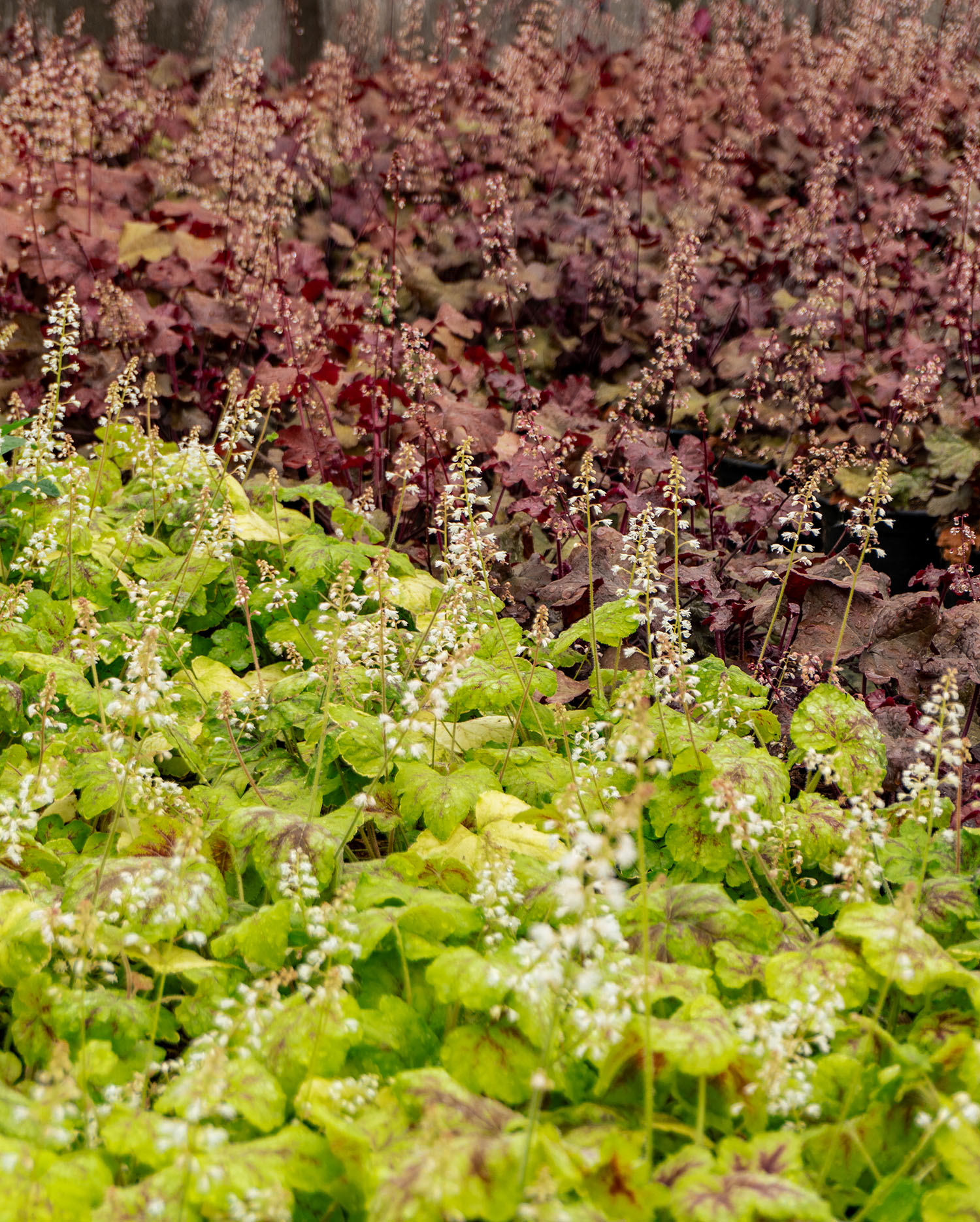
Heuchera ‘Yellowstone Falls’ and Heuchera ‘Red Sea’

Iris sibirica
Using late spring perennials in planting schemes
Late spring perennials are most effective when they are planted as part of a sequence rather than treated as isolated highlights. In sunny borders, combinations of Nepeta, Salvia nemorosa, hardy geraniums can carry a planting scheme from May well into July. The habit of these plants is also varied enough to make combinations work clearly. Salvias provide upright form, nepetas create low mounds, and geraniums help fill the gaps between stronger subjects.
In partial shade, the emphasis often shifts from prolonged flower to a balance of flower and foliage. Brunnera macrophylla, Tiarella cordifolia, Heuchera and Geranium phaeum are useful in this setting as they hold the ground well after flowering. They also connect naturally with spring bulbs, hellebores, epimediums and ferns, which makes them valuable in woodland-edge planting and shaded borders.
Where soil remains reliably moist, the planting palette can be broader. Astrantia major and Iris sibirica perform well in these conditions and help extend the season without the planting feeling heavy. This is particularly useful in larger borders and naturalistic schemes where continuity matters more than a short peak of flower.
Repeating a limited number of species or cultivars through a scheme is usually more effective than using many different perennials in single specimens. Repetition gives a border more coherence and helps guide the eye through the planting. Low-growing plants such as Alchemilla mollis, Geranium macrorrhizum and Nepeta are particularly useful for this, as they can link shrubs, roses and taller herbaceous subjects together while reducing exposed soil.
Planting considerations
The most successful late spring plantings begin with site conditions. Full sun, partial shade, dry soil, heavier ground and reliable moisture all point towards different plant choices, and performance is usually strongest where those preferences are considered from the outset. This is particularly important with perennials, as many will survive in less suitable conditions but will not give the quality of growth or flower expected from them.
Soil preparation is straightforward but worth doing properly. Removing perennial weeds and incorporating organic matter where needed will improve establishment, especially on light or poor soils. Moisture-retentive soils suit astrantias, brunneras and Iris sibirica, while salvias and nepetas are better in well-drained conditions. Hardy geraniums are among the more adaptable groups, but even these perform differently depending on light and moisture levels.
Mature size should also be considered early on. Some late spring perennials remain compact and are best near the front of a border, while others form broad clumps or send up taller flower stems that are better placed through the middle. Planting them too tightly can lead to congestion later in the season, particularly once neighbouring summer perennials begin to expand.
Aftercare and maintenance
Most late spring flowering perennials are uncomplicated once established. During the first growing season, watering is important while root systems develop, particularly in dry spells. Mulching in spring helps conserve moisture, supports soil structure and reduces competition from weeds.
After flowering, some perennials benefit from cutting back. Nepeta and hardy salvias often respond well to a trim, producing fresh foliage and sometimes a second flush of flower. Astrantias can also help extend the display. Other species, particularly those grown partly for foliage, may simply need spent flower stems removed so that the leaves stand out more.
Clump-forming perennials may need dividing after several years if the centre becomes congested or flowering declines. This is often the simplest way to restore vigour and maintain the balance of the planting. In most cases, however, long-term performance comes back to placement rather than intervention. A plant growing in suitable light and soil will usually need far less correction over time.
Late spring flowering perennials play a practical role in planting design. They maintain continuity between spring and summer, support pollinators, and give borders substance at a point when many schemes are in transition. They can be structural as well as ornamental, particularly when they are used to cover the ground, connect planting layers, or carry the scheme forward while later subjects are still developing.
If you would like more information on the species of perennials we grow and sell, speak to the G Team today.