


Planting on podiums and structural decks
What it takes to establish trees and planting over a structure rather than the ground
Landscaped decks over car parks, basement structures and retail units are now a common sight on new developments, from podium courtyards between apartment blocks to roof terraces several storeys up. Much of it looks like ordinary ground level planting, yet it sits on a structural slab with a building underneath.
As sites are built out more tightly, and planning expects usable green space and biodiversity on every scheme, the podium has become the place to put gardens, play areas and even trees where there is no open ground to use. It turns otherwise dead structural space into gardens for people and into forage and shelter for pollinators and birds above street level.
There is no natural soil profile, no deep reserve of moisture, and no room for roots to spread naturally. Everything the planting relies on, from growing medium to drainage to water supply, has to be designed and built into a shallow, sealed system. Most of what decides whether the planting succeeds happens below what anyone can see.
Getting that build-up right, and choosing planting that suits it, is what separates a podium garden that establishes and matures from one that struggles from its first summer.

Tower Bridge Court, Central London. Deck planting installed by Skidmores of Hertford, plants supplied by Greenwood.
What sits beneath a podium garden
At the base sits the waterproof membrane that protects the structure, usually paired with a root barrier that stops roots reaching the waterproofing. Above that, a drainage layer carries excess water to outlets, a filter sheet keeps fine material from clogging it, and the growing medium sits on top to support the planting.
The whole assembly has to work within a strict weight limit set by the structural engineer. A saturated growing medium is heavy, and every extra centimetre of depth adds load the slab has to carry. This is why podium planting is planned from the structural design stage rather than added later, and why coordination between the landscape and structural teams matters so much.
Substrate depth and what it allows
A shallow build-up of around 100 to 150 millimetres suits low, drought-tolerant planting such as sedums and tough perennials, while deeper zones of 300 to 600 millimetres open up shrubs and larger perennials. Trees need the most, often a metre or more, usually in dedicated raised zones or tree pits designed into the deck. Depth is the single biggest factor in what a podium can carry.
Because weight is limited, podium schemes use lightweight engineered growing media rather than heavy topsoil. These are free-draining and stable, though they hold less water and fewer nutrients than garden soil, which shapes both the planting choice and the aftercare that follows.

Water, in both directions
The free-draining build-up that protects the structure from waterlogging also dries out quickly in warm weather, far faster than open ground. For all but the toughest planting, some form of irrigation is usually needed, at least through establishment and often permanently.
At the same time, the system has to clear heavy rain quickly so water never backs up against the waterproofing. Drainage outlets need to stay accessible for maintenance, and planting should be kept clear of them. Rainfall on a podium can also be captured and reused for irrigation, which suits the sustainable drainage thinking now expected on new schemes.
Wind, sun and exposure
A podium several storeys up is windier, sunnier and more prone to reflected heat than the same planting at ground level, and wind in particular can scorch foliage and rock newly planted stock loose. Low, wind-firm planting copes best, and dense planting that shelters its own base establishes more reliably than isolated specimens.
Trees need particular care, because staking into a structural slab is not an option. They are held instead with below-ground guying systems or root-ball anchors that stabilise them without penetrating the waterproofing. Getting that anchoring right in the first season is what allows a tree to root firmly rather than loosen with every gale.
Planting that suits a podium
The planting that performs on a podium tends to share a few traits, tolerance of free-draining substrate, resilience to drought and wind, and roots that cope with a shallow, contained volume. The following all suit those conditions well.
Hylotelephium ‘Herbstfreude’ (Sedum ‘Autumn Joy’)
An upright succulent perennial reaching around 60cm, with fleshy grey-green foliage and flat heads of pink flowers that deepen to russet through autumn. It thrives in shallow, free-draining substrate and copes easily with drought, which suits an exposed deck. The late flowers are a valuable nectar source for bees and butterflies as the season closes.
Stipa tenuissima
A fine-textured, semi-evergreen grass forming soft tufts of thread-like foliage that move constantly in the wind. It tolerates drought and poor, free-draining soils, and its low weight and shallow roots suit a thin podium build-up. Planted in drifts, it softens hard architecture and catches low autumn light.

Hylotelephium ‘Herbstfreude’ (Sedum ‘Autumn Joy’)

Stipa tenuissima
Lavandula angustifolia ‘Hidcote’
A compact evergreen shrub with aromatic grey foliage and deep violet flower spikes through summer. It prefers full sun and sharp drainage, conditions a podium provides readily, and copes well with heat and exposure. The flowers draw bees and other pollinating insects in numbers through the summer months.
Cotoneaster URBAFLORA® ‘Urban Runner’
A tough, climate-resilient evergreen groundcover with lance-shaped grey-green leaves and a low, spreading habit. It tolerates drought, poor substrates and difficult exposed positions once established, which suits the demanding conditions of a podium. White flowers in early summer are followed by bright red berries that feed blackbirds and thrushes into winter.
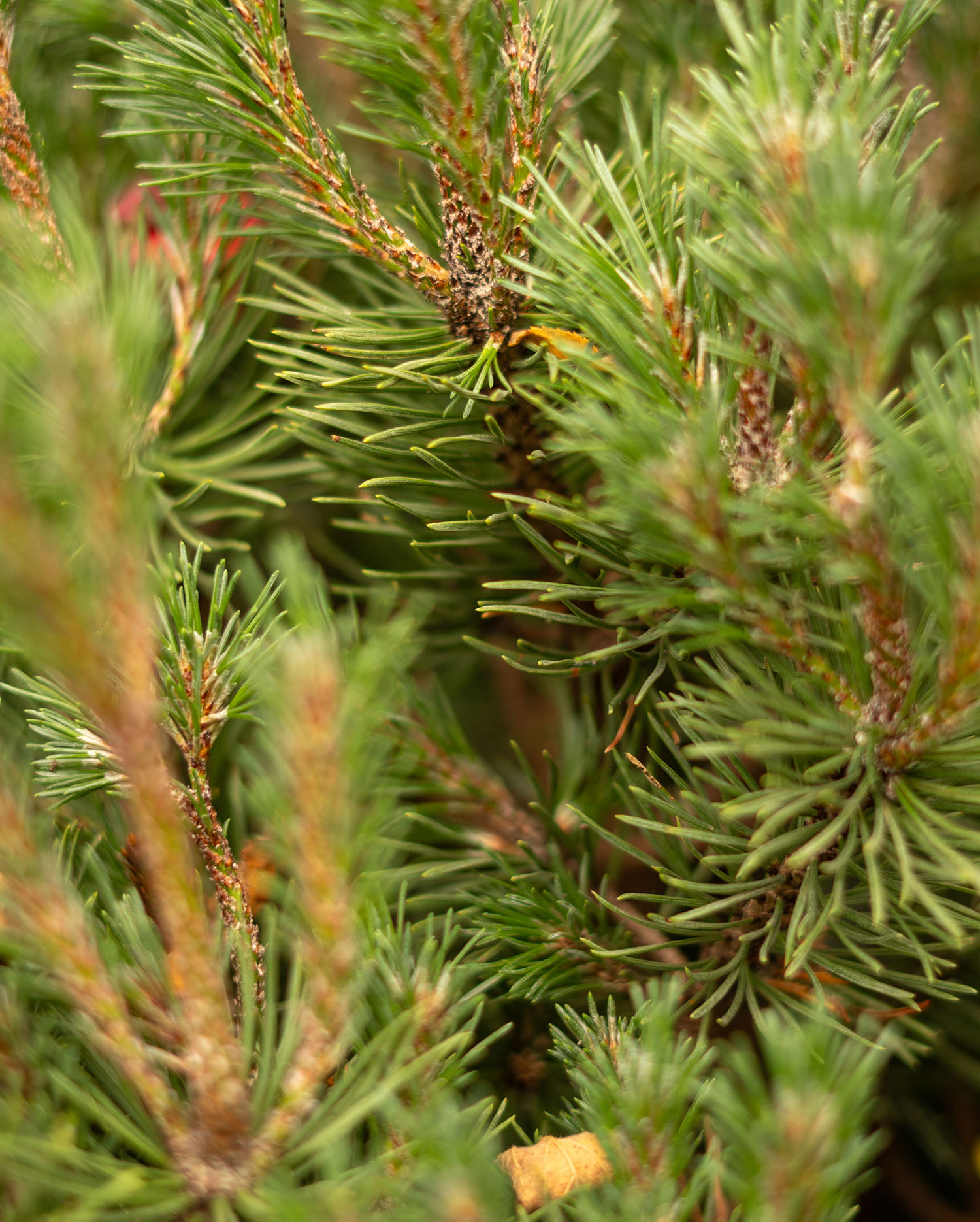
Pinus mugo ‘Mops’
A dwarf evergreen conifer forming a dense, rounded dome of dark green needles, slow-growing and rarely exceeding a metre. It copes with wind, drought and cold, and its evergreen structure holds interest through winter when much of a podium scheme has died back. It also gives year-round cover and shelter for small birds and insects.

Lavandula angustifolia ‘Hidcote’

Cotoneaster URBAFLORA® ‘Urban Runner’
Pinus mugo ‘Mops’
Where the build-up is deep enough, light multi-stem trees can be added for height and structure, provided they are anchored below ground and given a substrate volume that matches their eventual size.
For a worked example of a planting palette put together for exactly these conditions, take a look at our rooftop planting scheme.
Establishment and long-term care
The free-draining medium that keeps the structure safe also loses nutrients quickly, so a controlled-release feed and regular monitoring keep growth steady on a podium more than on almost any other scheme. Irrigation needs checking through every dry spell, particularly in the first two summers while roots establish.
Keeping drainage outlets clear, checking that the growing medium has not slumped or eroded, and topping up substrate where needed all protect the structure as well as the planting. A podium garden that is monitored and maintained can mature into an asset that lasts for decades, while one that is neglected rarely makes it past a few hard summers.
The appeal of a podium is that it turns unused structural space into gardens, amenity and forage and shelter for pollinators and birds where there would otherwise be none. Delivering that reliably comes down to the parts that are never seen, the build-up, the drainage, the anchoring and the aftercare, as much as the planting on top.
At Greenwood, we work with the teams designing these schemes to match planting to the depth, weight and exposure of the deck, and to supply stock that is ready to establish in demanding conditions. Grown peat-free and to Plant Healthy standards, it gives a podium scheme a resilient, biosecure start.
For more information about planting for podium and roof deck schemes, speak to the G Team today.