


Narrow-crowned trees for streets and tight spaces
Choosing upright and compact trees that fit the space they are given, now and in twenty years’ time
A residential road on a new development often squeezes the building line, the footway, parking bays, the carriageway and underground services into a few metres of ground. The trees are expected to fit somewhere among them. The space above ground is usually as tight as the space below it, with first-floor windows, street lights and passing vehicles all close to where the crown will eventually be.
A tree chosen for its size in the nursery rather than its size at maturity is usually where the trouble starts. Within fifteen or twenty years a broad-crowned species planted a few metres from a house front can be shading rooms, brushing gutters and overhanging the road. The usual response is repeated crown lifting and reduction, which costs money every few years and rarely improves the tree. In the worst cases it is removed altogether, and the canopy the scheme was designed to deliver is lost.
Narrow-crowned trees are selected forms of familiar species, grown for an upright, columnar or compact habit, that keep a crown of roughly three to six metres across for many years where the parent species would spread much wider. They give height, seasonal interest and shade over the footway without reaching the building or the carriageway, which avoids most of those problems.
The rootballed and bare-root season opens in late autumn and runs to the end of April, which is when most street trees go into the ground, so the weeks ahead are the time to settle species, sizes and quantities.
What makes a crown narrow
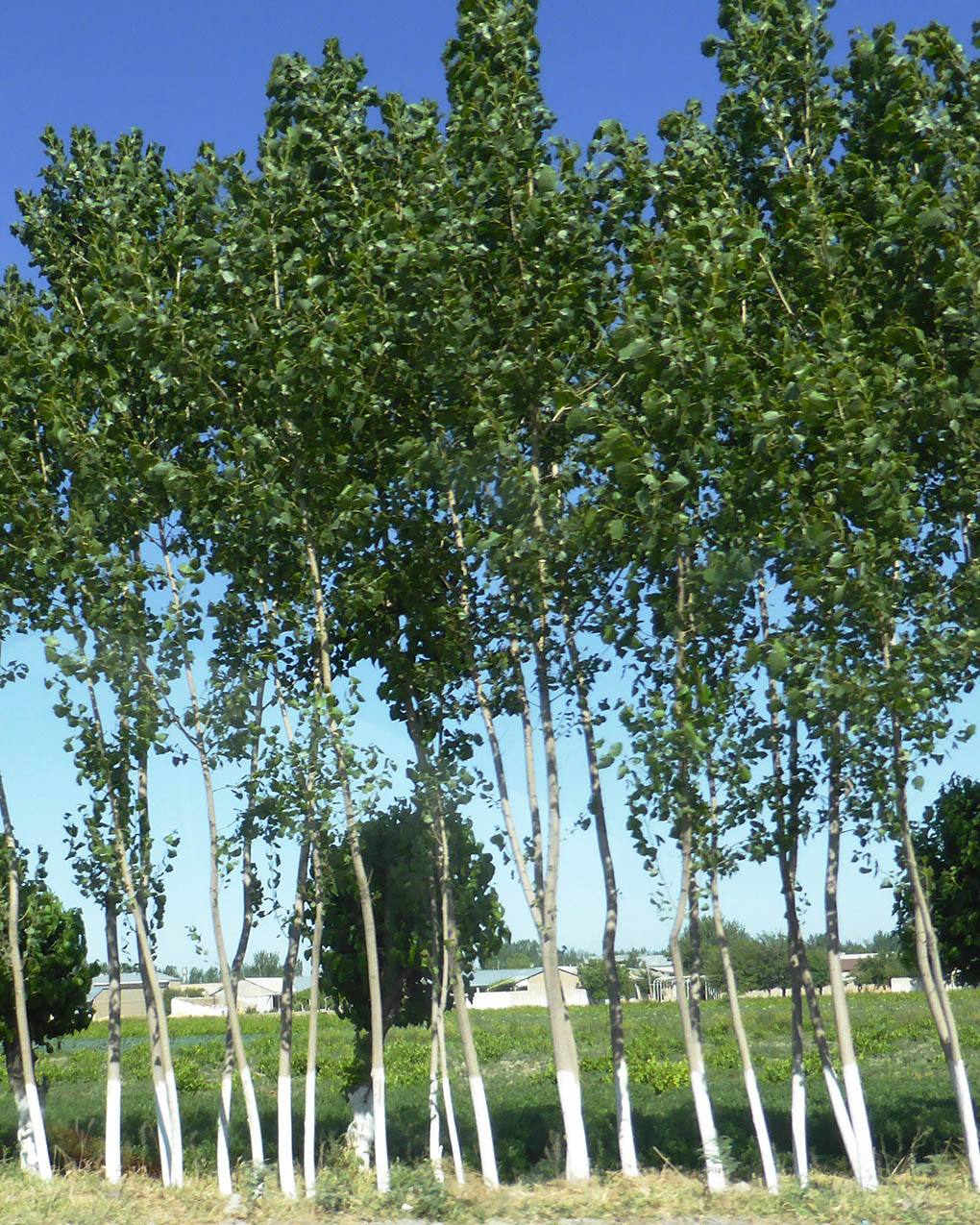
The narrowest trees are described as fastigiate, from the Latin fastigium, meaning a gable or summit. Their branches grow steeply upwards, almost parallel to the trunk, so the tree forms a column or a narrow flame rather than spreading sideways. The Lombardy poplar is the best-known example, and many fastigiate street trees are selections of a wider-growing species that happened to produce an upright seedling or branch.
Conical and oval crowns are also common among street trees. A conical crown is broad at the base and tapers to a point, while an oval crown is wider through the middle and rounded at the top. Both suit streets well, but they need more room than a true column, and the difference becomes obvious once the tree is mature.
Several cultivars that are slim and upright in their first ten years open into a broader oval later, so it is the mature width, not the shape of the tree on delivery, that should decide whether it fits the space. Because most of these cultivars are propagated by grafting or budding rather than from seed, the trees tend to grow to a similar, predictable form, which is what makes them practical to specify.
Planning for the crown, the stem and the roots
A clear stem, the length of trunk below the first branches, is what keeps the canopy above pedestrians, cyclists and vehicles, and it should be stated on the plant schedule alongside the girth so the trees arrive ready for the position they are going into. Upright trees are well suited to this, since their branches rise away from the footway rather than across it.
A narrow crown does not mean a small root system, and below ground street trees often face heavy competition for space. Compacted ground, sealed surfaces and services leave little soil for the roots, and a tree in a small pit can survive for years without ever growing properly. The Trees and Design Action Group’s guide Trees in Hard Landscapes sets out how structural soils and load-bearing soil cells can give trees enough rooting volume beneath paving, and those decisions belong at the design stage, since they are far harder to add once the street is built.
Some trees cope with paving over their root zone and with the drought, heat and reflected light that come with it, while others need open, unsealed ground to do well.
Narrow trees for the tightest spaces
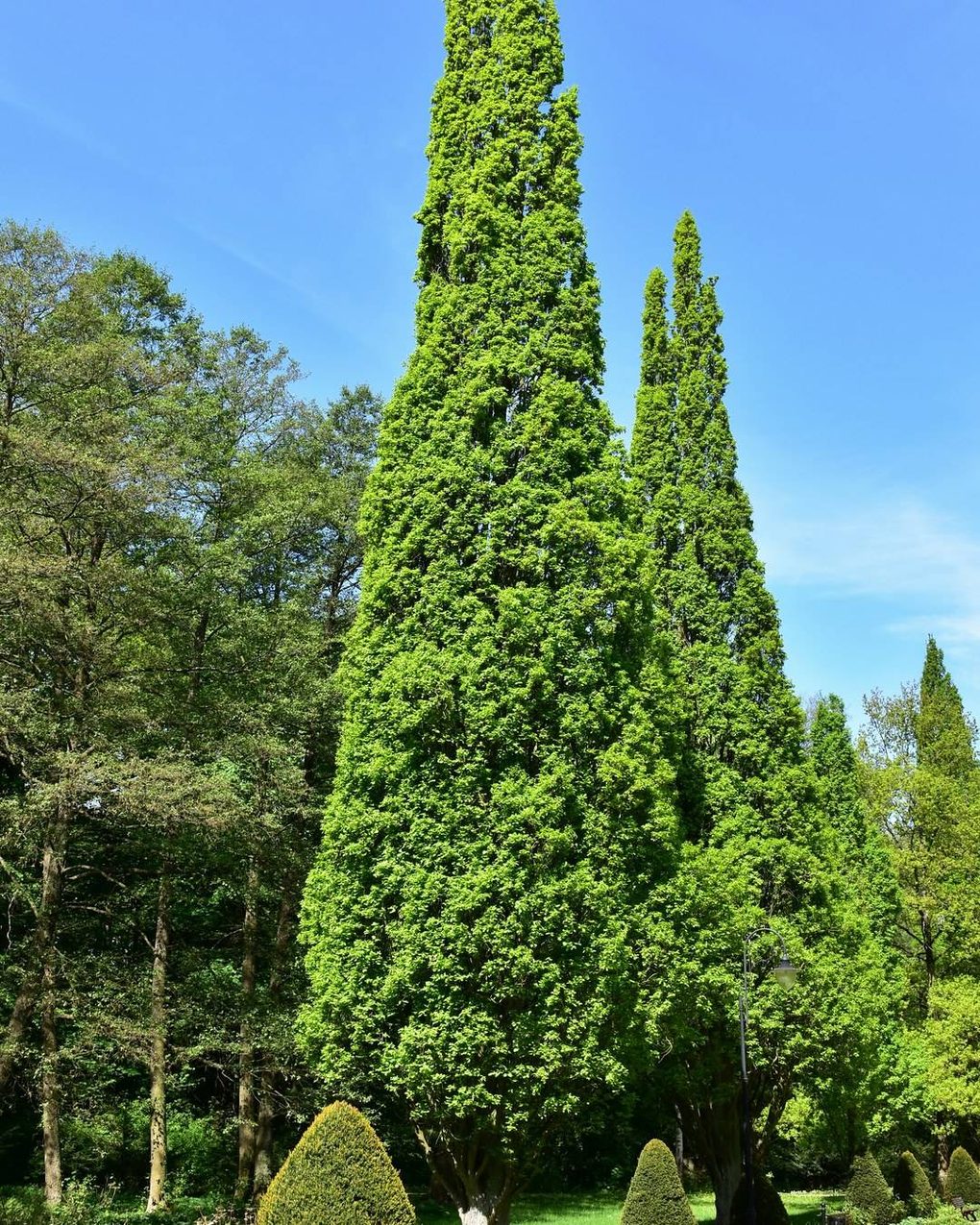
Carpinus betulus ‘Frans Fontaine’
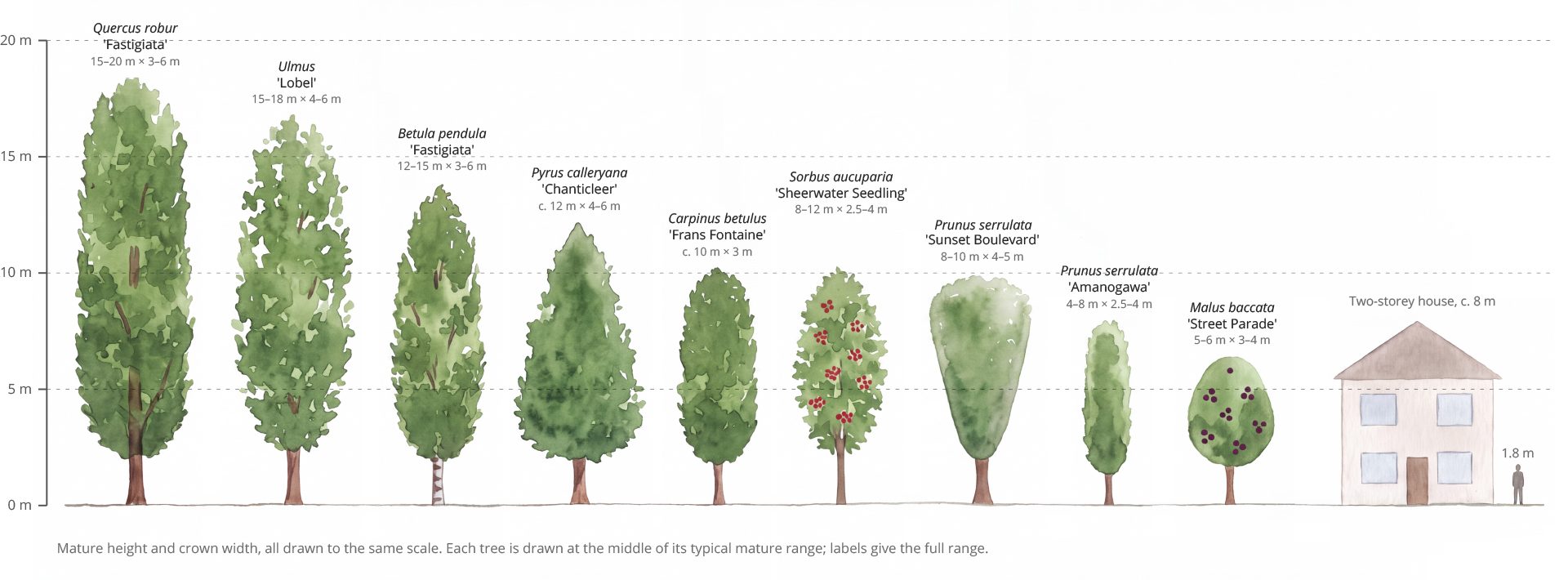
The narrowest of the hornbeam cultivars, forming a compact, dense, dark green column around 3m wide at 10m in height, and keeping that shape as it matures. The leaves turn yellow in autumn. It tolerates paving, makes few demands on soil and copes with wind, which makes it a dependable choice for narrow streets, courtyards and spaces close to buildings.
Betula pendula ‘Fastigiata’
An upright form of the native silver birch, with a columnar crown typically 12m to 15m tall and 3m to 6m wide. It keeps the white bark, catkins and yellow autumn colour of the species in a fraction of the width, and suits streets, avenues and central reservations.
Quercus robur ‘Fastigiata’
Commonly known as cypress oak, Quercus robur ‘Fastigiata’ is a columnar form of the native English oak with strongly ascending branches and a dense, dark crown, reaching 15m to 20m in height and around 3m to 6m across. It tolerates paving, de-icing salt and wind, and is well suited to narrow avenues and streets. Trees raised from seed can vary a little in form, which is worth bearing in mind where a perfectly matched avenue is wanted.
Ulmus ‘Lobel’
A Dutch elm bred at the De Dorschkamp research station in Wageningen, and the narrowest of the four elms released from its third generation of breeding. The crown is narrow and pyramidal when young and becomes a dense oval later, around 15m to 18m tall and only 4m to 6m wide. It was selected for its resistance to Dutch elm disease, which is good though not total. It copes well with wind, salt spray and poor ground, so it suits long residential streets and exposed coastal schemes.
Pyrus calleryana ‘Chanticleer’
Commonly known as Callery pear, ‘Chanticleer’ forms a narrow, conical crown around 4m to 6m wide on a tree reaching about 12m, and stays considerably narrower than older selections such as ‘Bradford’. It comes into leaf early, carries abundant clusters of white flowers in April, and holds glossy, dark green leaves late into the autumn before they turn yellow and red. It resists air pollution and wind, including coastal wind, copes with paving and makes little demand on soil. Fruit rarely forms, so there is very little to clear from footways.
Prunus serrulata ‘Amanogawa’
A small, narrowly fastigiate flowering cherry, reaching 4m to 8m in height with a spread of 2.5m to 4m. Semi-double, pale pink flowers open in late spring, and the leaves colour orange and red in autumn. The upright form fits front gardens, small squares and the narrowest planting strips, where a spreading cherry would quickly outgrow the space. It holds the RHS Award of Garden Merit and performs best in full sun.
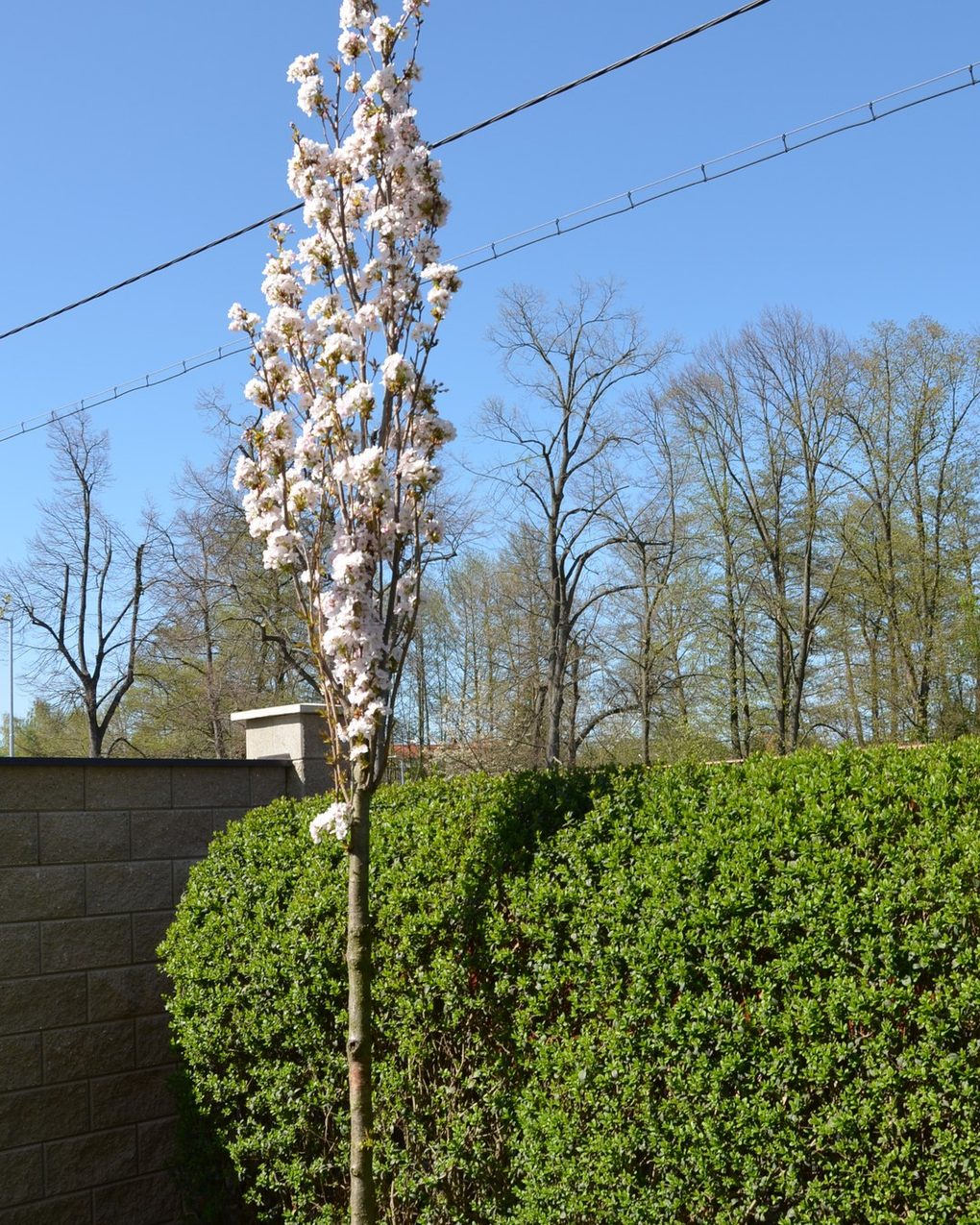
Prunus serrulata ‘Sunset Boulevard’
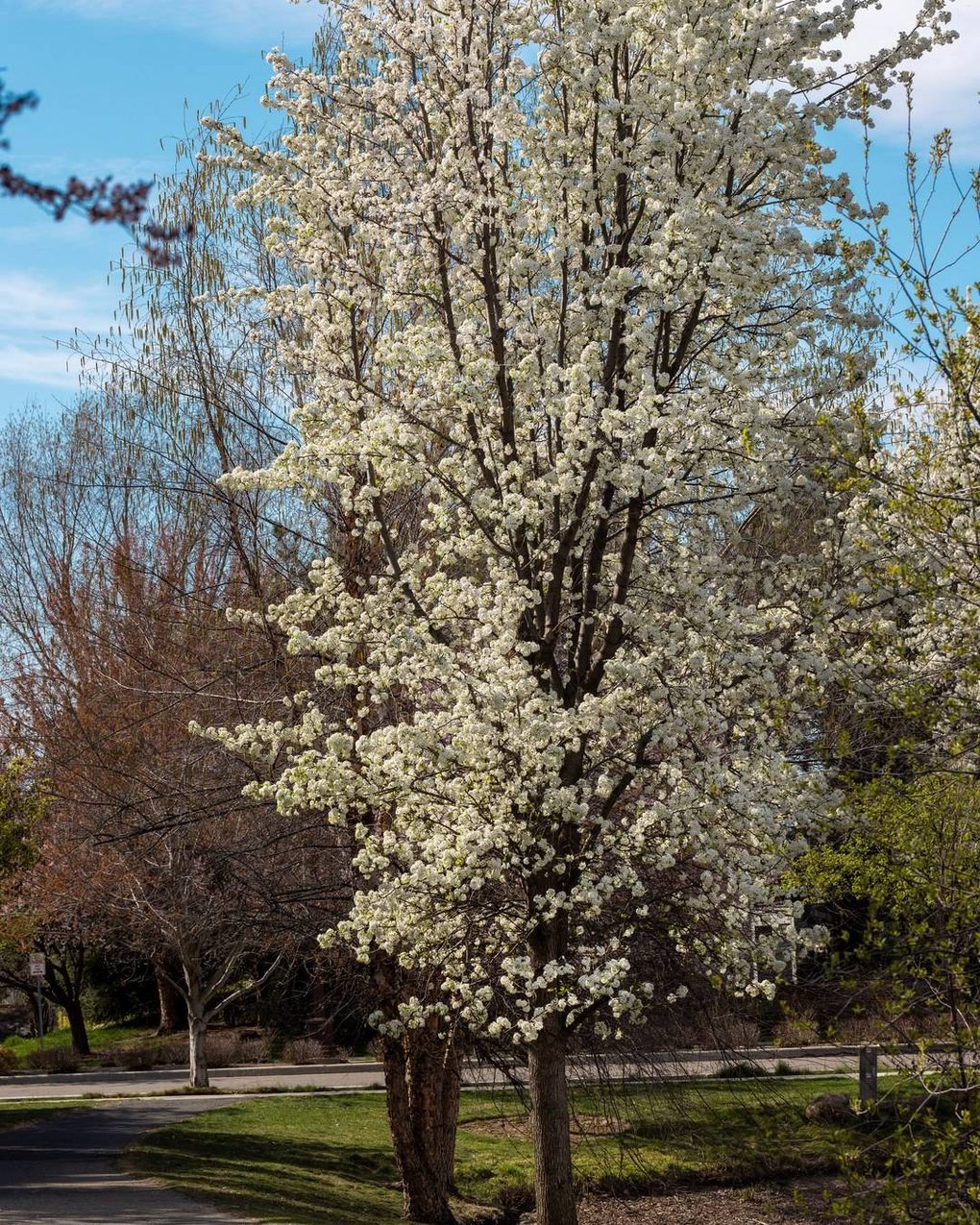
A narrow, vase-shaped cherry with short side branches, reaching around 8m to 10m in height and 4m to 5m across. Single white flowers with a pink edge open in April, and the foliage turns red and purple in autumn. It dislikes waterlogged soil and does not tolerate paving over the root zone, so it belongs in verges and open planting beds rather than in hard surfaces.
Malus baccata ‘Street Parade’
A small Siberian crab apple with a narrow, egg-shaped crown, typically 5m to 6m tall and 3m to 4m wide. Pink buds open to pure white flowers in late April and May, followed by small, shiny, purple-red fruit around 1.5cm across. The flowers are a good source of nectar and pollen for bees and the fruit is taken by birds. It tolerates paving, is free of mildew and only slightly susceptible to scab.
Sorbus aucuparia ‘Sheerwater Seedling’
A vigorous selection of the native rowan with an upright, narrow habit that broadens a little with age, reaching around 8m to 12m in height and 2.5m to 4m across. Creamy-white flowers in April and May are followed by large clusters of red berries that last into winter and feed blackbirds and thrushes. It prefers full sun on well drained, neutral to acid soil and takes exposure well.
Sizes, root forms and the planting season
Street trees are specified by girth, the circumference of the trunk measured one metre above the ground. A tree of 12-14cm or 14-16cm girth already looks established on the day it is planted and is better able to withstand casual damage than a smaller one, while still settling in reasonably quickly. Larger trees make an immediate impact, but they need more aftercare and generally take longer to establish. ‘Chanticleer’, ‘Sunset Boulevard’ and ‘Lobel’ are part of our G Range for the 2026 to 2027 season.
Rootballed and bare-root trees are lifted from the field in the dormant season, which runs from late autumn to the end of April. Container-grown trees can be planted at any time of year, which helps on schemes where the programme does not allow a winter planting window, but they still need watering through their first summers. Whichever form is chosen, the first three years decide how well a street tree performs, and the aftercare covered in our earlier blog on getting new planting through its first three years applies just as much to trees as to shrubs and perennials.
The right street tree is the one that still fits its space when it is fully grown. Choosing by mature width rather than nursery shape, planning the soil before the paving goes down and ordering early in the season gives a street the best chance of keeping its trees for decades.
For more information about narrow-crowned trees for streets and tight spaces, speak to the G Team today.